
| Frequently Asked Questions |
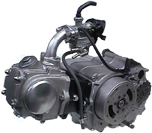
Thank you for inquiring on the Honda Minitrail motor restoration service.
Section 1: My Customers
Please keep in mind that I primarily cater to an individual who is interested in having an original engine restored back to factory specs to use in a very thorough minitrail restoration. What I don’t offer is a quick “freshen-up” consisting of a ring job & engine spruce. I don’t do that type of work and please do not ask me to perform an incomplete job for less money. My work is very thorough and the price reflects the necessary attention to detail and many hours required to get one of these little engines back to they way the ran and looked 40 or so years ago & to run for another 40 years. I perform engine restorations. I have some photos of an engine being tested on a test bike before it is to be shipped back to its owner that I will send along upon request.
Section 2: Carburetion
In my restoration service, I do not rebuild carburetors. I have done extensive testing on old carburetors & i have found that over time the original carburetors for these machines have become warped, worn, and clogged. No matter how "clean" you get these old carburetors, too often they will simply not work well enough to compliment the restored engine & will only serve to cause grief to anyone operating the bike or trying to get the bike to carburate properly. All customer engines are run on a test bike before being shipped back to the customer so that i can personally verify the ease of starting, transmission shift quality, ride quality and idle quality. I cannot perform my testing with your original carburetor. I offer genuine Honda retrofit replacement carburetors which are the same one I use in my testing of your engine. I strongly suggest that all of my customers purchase a carburetor kit for an older bike simply because it eliminates the very high level of grief that an old warped carburetor can carry with it. If you purchase one of my retrofit carburetor kits along with along with your engine restoration, I will test your engine with your new carburetor installed & ship the entire package back to you, tested, tuned & one-kick-ready. If you are not purchasing a carburetor along with your restored engine, I will test your engine with my own carburetor to ensure that the engine will perform up to my high ride quality standards.
Z50's
Hard Tail (for early model Z50's like the K0,K1 & K2 that have no rear shocks)
One of my all-Honda retrofit carburetor kits for any hard tail model Z50 will add $165.00 when purchased along with an engine restoration This kit includes the necessary air filter housing adapter pictured on the carburetor page. Please be sure to send your intake tube to me along with the engine if you would like one of my kits. Aftermarket gray throttle cables that fit the kit are available for an additional $15.00 but there is always a limited supply. Please email me first if you are interested in a gray cable so i can do my best to assure that you can have one go back with your restored engine.
Soft Tail (For K3 - 1978 Z50's with rear shocks)
One of my all-Honda retrofit carburetor kits for a soft tail Z50 will add $150.00 to your total when purchased along with an engine restoration. It includes a new black cable. Regardless of the type of engine you are sending, please send along your intake tube taped to the underside of the cylinder (it won't get damaged in shipping there). Aftermarket gray cables throttle that fit the kit are available for an additional $15.00 but there is always a limited supply. Please email me first if you are interested in a gray cable so i can do my best to assure that you can have one go back with your restored engine.
1979 & newer.
I sell a carb kit for this model, but it does not come with a cable because the bike came standard with a black external throttle cable, so there is nothing special about it. I can get you a cable along with this kit if you like but it is no different than the original Honda throttle cable & can be purchased where Honda motorcycle parts are sold if you feel you need one. www.dratv.com sells them according to your year. Email for current pricing.
CT70's
A new Honda retrofit carburetor kit for a CT70 are will add $180.00 to your total when purchased along with the engine restoration. It includes which includes a new cable and a few additional parts necessary to facilitate the newer style OEM Honda carburetor I employ. Installation of the kit will require a slight modification to the intake tube as well. Regardless of the type of engine you are sending, please send along your intake tube taped to the underside of the cylinder (it won't get damaged in shipping there). If you happen to be sending a CT70 engine and are not purchasing one of my carburetor retrofit kits, send your intake tube anyway, as I will modify it to accept the retrofit carburetor that I sell. This way, if you decide to go with my retrofit carburetor down the line, i can just ship the kit to you & do not need the intake tube to modify. The modification that i perform does not effect it's use on the standard/original carburetor. It is only a slight notching of the mounting holes where the carburetor bolts to the intake tube.
Aftermarket gray cables are available for an additional $15.00. Limited availability, so please email me first if you are interested.
Regardless of the type of engine you are sending, please send along your intake tube taped to the underside of the cylinder (it won't get damaged in shipping there). If you happen to be sending a CT70 engine and are not purchasing one of my carburetor retrofit kits, send your intake tube anyway, as I will modify it to accept the retrofit carburetor that I sell. This way, if you decide to go with my retrofit carburetor down the line, i can just ship the kit to you & do not need the intake tube to modify. The modification that i perform does not effect it's use on the standard/original carburetor. It is only a slight notching of the mounting holes where the carburetor bolts to the intake tube.
Section 3: Optimal running set up for CT70.
The CT70 carburetor kits I offer are jetted to run on a stock exhaust with no end baffle. These bikes are not horsepower kings to begin with & the muffler baffle REALLY kills the power. The bike is only slightly quieter with it in. If the end of your CT muffler has a rod about the diameter of a motorcycle wheel spoke in it, running diagonally across the end of the outlet, the muffler has a baffle in it. Will make the bike runs a considerably better. The carburetor kits are jetted specifically without the baffle in. If you leave the baffle in, there is no guarantee that the engine will l run optimally due to the excessive back pressure. If you can't get the baffle out, a little heat from a plumbers torch right at the end of the exhaust will burn off the carbon in the area, allowing you to pull the baffle with a pair of channel locks or pliers.
Section 4: The need for proper carburetion.
I make very little profit on the retrofit carburetors & I only offer to sell them to satisfy the needs of my customers. because i feel very strongly that the original carburetors should not be used. Many prospective customers are under the impression that their carburetor is fine. When you receive your engine back from me, & you experience some sort of technical difficulty that can be traced to a problem with the original carburetor, I cannot assist in this area & can only recommend a new carburetor. I only stand by this policy because diagnosing & repairing problems related to the original carburetors could easily be a full time job in itself. If your carburetor has been well maintained, you may not need a newer carburetor. I have several 30+- year old classic Honda minis with original carburetor, but it's not likely that any of my personal bikes were ever left to sit for more than a few weeks at a time without having the fuel being drained. They have also had overhauls on a regular basis and have been very well maintained. If your carburetor is suspect, I will be forced to recommend a replacement carburetor kit ,as it no longer makes sense financially for the customer or myself to rebuild these carburetors. If your carburetor is in good shape, great. Please consider my advice based on my experience so you do not feel like this customer.
Section 5: Why my carburetor kits work & what doesn’t work
I have performed a great deal of testing with these newer carburetor set-ups and when installed, these bikes run GREAT! The original CT carburetor varies only slightly in appearance since the updated carburetor's bowl is round and it has a new-style plastic choke knob. The choke and petcock are on the correct side, which is more than can be said for the Chinese aftermarket carburetors. These are being marketed to the unsuspecting minitrail enthusiast who thinks he’s getting the genuine article. DON’T buy a carburetor that’s not made by Keihin. Just because it has a “K” logo PRINTED on the side, doesn’t mean that it’s a Keihin. REAL KEIHINS have the ENTIRE name EMBOSSED on the side. DON’T buy a carburetor without asking what brand it is!
Section 6: Retrofit Carburetor Kit Outward Appearance.
Hartail Carburetor Kits.
My Hard Tail retrofit Z50 carburetor kits are very close in appearance. The original carb kits had a different style of choke lever & my kit for this paricular bike warrants the use of a rubber air filter adapter that is a Honda part. You can see a pic of my retrofit carburetor kit installed on a Hard Tail Z50 on the carburetor page. If you are having a hardtail engine restored, and want a new carburetor, please send your intake tube. Unlike the later Z50's , I can only modify the tube if you plan on using the updated carburetor because i remove the studs, drill the threads from the holes & use traditional bolts to hold the carburetor on. The modification will complicate the use of the original carburetor, so I will only modify a hard tail intake tube for someone who wants a new carburetor at the time of restoration.
Soft Tail Carburetor Kits.
My retrofit Z50 carburetor kits for Soft Tail Z50's are identical in appearance to all of the K4-78 model Z50's.
Section 7: What an engine rebuild entails
Cylinder bore specification & option:
During the rebuild process, the cylinder is measured to assure it is well within the wear specification. Often the cylinder bores are very well within specification, and are only in need of a de-glaze, which I perform. If by chance the cylinder is out of spec, i replace it, as at this time, it is not cost effectivce to resize the cylinder to the next size up. I am actively seeking a cost effective manner to reduce this cost & pass the savings on to the custoner, but for right now, i simple replacement of the cylinder is the most cost effective route. Replacing the cylinder is $100.00
The remainder of the rebuild process entails the following: The cylinder is media blasted of all of its original paint & is repainted with a high gloss, high temprature black paint & baked in an oven which makes the finish resistant to fuel. The valve seats are cut & valves and lapped in. The right and left side engine covers are media blasted & the engine covers are painted with an laquer based paint that is a dead match for the original Honda “cloud” silver. The paint resists fuel so you don’t have to go nuts trying to keep raw fuel from touching the fresh paint during your installation. All internal engine components go through a rigorous cleaning process. Keep in mind that if your external left or right engine covers are scratched, they will be smoothed out during the process. If they require filling, please let me know & I will do the best I can without spending days on them. If you’re doing a 100 point restoration, but you have a badly gouged cover, it may not come out to your liking & you may want to purchase a new cover. This is a very rare instance & I have only experienced this once or twice in the several hundred restorations that I have done. Also during the rebuild, the cylinder head & engine case halves are bead-blasted & left bare as they were delivered from the factory. The spark plug threads are chased as well as every single hole on the engine (As depicted here). All of the visible hardware is replaced except for the 2 underside 14mm & 17mm bolts & the exhaust studs. The exhaust studs are media blasted along with the cylinder head, but not replaced. The studs are barely visible with the exhaust in place & removing them usually results in them breaking. At that point they require special machining to remove them which can cost up to $50 per stud. I don’t remove or replace the studs unless there is a need to. Keep this in mind if you’re sending an engine with one or both of the engine studs broken or damaged. All internal engine parts (transmission is included in the engine) are inspected for wear & checked to assure they are within specification. The transmission shift fork guide pins are replaced to assure positive shifting qualities, which is a key element of my work. Transmission shift fork wear is evaluated at this point & noted. About 1 in every 15 engines is in need of a transmission shift fork & 1 in every 30 is in need of both. I'm just trying to educate a persepctive customer as to the liklihood of an additional charge for a possibly worn shift fork. Also, if your engine shifts fine, it's not likely that there is any need for a shift fork replacment at all. All transmission gears, shift drum & related parts are checked to assure that a fresh engine will last for generations if maintained correctly.
Section 8: What parts are included in an engine restoration?
The cost includes the replacement of the parts and the labor listed below.
• Piston
• Rings
• Piston circlips
• All new gaskets, seals and O rings
• All new external engine hardware (except oil drain bolt & exhaust studs. See section 7)
• Clutch friction plates
• Cam chain (also known as timing chain)
• Both cylinder head tappet inspection covers (17mm covers)
• Cam sprocket cover (big round cover on the left side of the head)
• Spark plug wire guide (On the right side of CT70 cylinders)
• Carburetor overflow line guide (on the left side of the engine, forward of the engine cover)
• Ignition breaker points
• Oil dipstick
• Spark plug
• Crankcase breather hose
• Re-sheathing of stator wires to harness connector
Section 9: Supplemental needs not included in rebuild
Here’s a short list of items that sometimes require replacement, but are not included in an engine restoration & require an addition fee.
• Kickstart shaft ($40.00)
• Shift shaft ($30.00)
• Shift forks ($40.00 each)
• Intake valve ($20.00)
• Exhaust valve ($20.00)
• Machining of valve seats for above valve replacement ($10.00/each seat + cost of valve as above)
-e.g., Replacement of intake valve = $20.00 for intake valve, $10 for machining of seat = $30.00
• Helicoil thread repair - 8mm underside step bar mount holes (upon inspection) - ($15.00/each hole)
• Helicoil thread repair - any 6mm hole - ($8.00)
• Helicoild thread repair spark plug hole ($20.00)
These items are replaced on an as-needed basis. The need to replace these items varies from engine to engine & is usually dependant on how the engine has been cared for throughout its lifetime.
• If the kickstarter was never tightened during routine maintenance & the splines have become significantly damaged, this would require the replacement of that shaft.
• The same applies for the shift shaft. As well, if the bike has had more than it’s fair share of being dropped on it’s left side, the shift shaft may be badly bent. I do charge $15 to straighten them when straightening is possible.
NOTE: You can check the splines on both shafts when you are trying to determine if you would like to have your motor restored. If they seem worn or are obviously bent, you should figure that into your overall cost.
• Shift forks can wear depending on the level of abuse the bike has experienced & if the engine was ever run out of oil. If your bike shifts OK, it's not likely that it requires a shift fork. (there are 2 shift forks)
• Engine valves are sometimes worn beyond specs & cannot be cut to suit.
Section 10: What a restoration does not include
It does not include any crankshaft or transmission parts or labor. It does not include kick-start shaft/shift shaft replacement, intake/exhaust valve replacement, thread repair, engine case repair or stator repair. All parts are inspected, but there is an additional charge for any necessary parts or labor associated with the items described here. It’s nearly unheard of that any of the above items are ever damaged, but I need to mention it so that someone doesn’t pull a motor from a pond & expect to incur the minimum cost .
Section 11: Test Process
A key aspect of my restorations is that upon completion, you’re engine is installed in a test chassis & ridden for at least 15 minutes. During the test I personally assure ease of starting, shift quality, idle quality in neutral as well as in gear (automatic models), proper acceleration and deceleration aspects & steady cruise quality. Any and all adjustments necessary are made & rechecked before the motor is returned to you. This assures that the installation will go silky smooth for you & removes any question as to if the motor will work for you as it would for me. My test process assures me that I can test the running condition of your engine before it is returned to you. There are only 3 possible items on your bike that could cause your engine to run poorly for you, but not for me.
Those 3 items are:
1) Exhaust
2) Ignition coil
3) Carburetor
• The only way your exhaust could cause a problem is that if it were so dented or clogged so as to completely block flow. This would have to be a deliberate act & I have never heard of it happening.
• I have yet to see a Honda ignition coil go bad in my 20 years working on Honda motorcycles. They simply do not fail but it is possible and must be considered.
• The most probable cause for a poorly running restored engine IS the carburetor. Please be sure to that you have read the extensive information on this page with regards to how having a good carburetor is central to a good running engine.
The reason I am going through the possible scenarios is that you need to feel secure that your engine will be returned to you running like new. The best way for me to make you feel at ease is to describe all possible scenarios and assure you that they have been worked through. I stand behind my work & should you have some sort of issue with your engine, I will work through it with you to the point of resolution. I don’t mind if you want to use your old carburetor as it may work fine. I am only making you aware of what I deal with every day.
Section 12: What can be expected
The engine will be returned to you looking like a factory original engine or better. Engines do not get shipped unless they work as they were designed. I do not ship an engine back to its owner unless pushing the kick-starter by hand will result in the engine starting. This is so even the smallest of riders can start the bike and learn to ride just like you did all those years ago. When your engine is returned to you it will look very close or identical to the way it was assembled at the factory. YOUR ENGINE IS RETURNED WITHOUT OIL IN IT FOR SHIPPING REASONS!
Section 13: Z50 & CT70/CL70/SL70 Engine Rebuild General Info
Standard engine restoration charges are as follows:
• Z50 any year $690.00 (includes black plastic insulator for between intake tube & cylinder head).
• 3 speed automatic clutch CT70 $680.00
• 4 speed manual clutch CT70 $700.00
• CL/SL70 $700.00 (Retrofit carb kits available. Please email if interested.)• If your engine requires the next size over cylinder bore there is an addition $100.00 charge. (see section 7)
• The current UPS shipping/handling rates are between $45 and $65 inside the continental U.S.
• The overall restoration cost is a direct correlation to the quality of work you will receive, which is second to none. I do not run a “core shop”. That is, I don’t send you someone else’s motor back to you. What you receive back is YOUR motor, completely rebuilt utilizing all my 25 years of Honda knowledge and experience. This will maintain your matching number authenticity. I use all Genuine Honda parts where available in my standard poppet restorations. Tested, tried-and-true aftermarket parts are utilized only in the very rare instance when & where Genuine Honda is not, available or when upgrading to power-up components.
Section 14: Determining additional needs.
Please be mindful that an engine that has had makeshift repairs or jerry rigging in some area will returned to stock specification. Any threaded hole that has been drilled out & tapped to accept a larger bolt will be refurbished & it will all be returned to standard spec. I do this to ensure that your engine will be the same as when it when it rolled off the showroom floor, with no unusual work that could stump another ordinary mechanic years from now.
If there are an inordinate amount of additional needs, I will email you prior to doing any work.
Out of the few thousand Minitrail engine restorations that I have completed, I have only turned away a couple of engines because they were more work than was worth getting another used engine to start with.
One time an engine was brought to me after it had been pulled from a body of water. No internal or external parts were serviceable.
In another instance, a customer sent in an engine from a bike that had been parked under a gutter downspout of his home for a few decades. It was seized & completely frozen, which is normally not that big a deal. However, that customer made an an attempt to clean the engine with a large industrial de-scaling power tool that is used to strip the paint off or highway bridges. He destroyed all of the external components it in the process. I think those are the only two customers that i advised strongly that they furnish another used engine for their project.
Somewhere in between a great running engine & a totally useless one is your engine. You may be able to get an idea of additional needs by looking at the overall condition so you can know what to expect. Most folks that send a really rough engine are not that surprised when I inform them that there were some additional needs.
Don't bother cleaning it. I have very expensive cleaning industrial cleaning equipment & won't complain at all no matter how dirty it is. Just make sure the oil is out of it.Section 15: Deposit & Payment
You will notice on the shipping sheet that goes with that gets shipped along with the engine that I ask for a deposit of roughly 50% with the engine shipment and the balance upon completion of the job. Personal checks are fine for deposit & balance.
Section 16: Completion time
All work is performed on a first come-first serve basis. Currently my turn around time is between 6 to 8weeks from when I recieve it. If you have any other questions, please e-mail me. If you are interested in sending an engine, please let me know and I will reply with the shipping address and to whom payment should be made.
Section 17: Checklist
Please refer to this checklist to properly carry out the shipping of the engine.
| Site Update |
MotoEnzo.com has been updated to provide you with the same great service and an easy browsing expirence. |